
Aviston Sportsplex impact is best assessed through two lenses: what the planned indoor facility can change for youth sport access, and what evidence from comparable sports venues says about local spending. As of September 3, 2026, the Clinton County Sportsplex in Aviston, Illinois, was under construction, with no later opening status verified in the supplied research. That timing matters because any economic claim should be treated as a planning estimate until operators can report bookings, attendance, visitor origin, concession activity, and tournament use.
Facility Scope And Sports Use Cases
What The Aviston Facility Was Planned To Include
The planned Clinton County Sportsplex was described as a 15,000-square-foot indoor complex with two full-size basketball and volleyball courts, a 5,000-square-foot indoor turf field, four full-size batting cages, and two HitTrax baseball and softball simulators. The same project description included a concession area, a mobile app-based reservation system, and an intention to host tournaments, according to the SIUE project notice.
For a youth sports community, that mix is not just a building specification. It signals the sports the operators expected to serve: basketball, volleyball, baseball, softball, and field-based training on turf. The courts can support team practices and smaller competitions. The turf area can help field-sport athletes maintain technical work during weather-limited months. Batting cages and simulators can support repeatable skill sessions for baseball and softball players, especially where outdoor field access is less reliable.
The planned booking system is also worth watching. Reservation software can reduce friction for clubs, coaches, and families if it gives clear availability, consistent pricing, and predictable time blocks. Facility planning, reservation technology, and venue operations also connect with broader design and production workflows analyzed by CAD/CAM Net, particularly where small communities are trying to turn a physical space into a usable training asset.
Why Indoor Capacity Changes The Coaching Calendar
From a coaching and club management standpoint, the main sporting value is continuity. Outdoor youth teams often lose training time during winter or extreme weather. Indoor courts, turf, cages, and simulation tools can protect a development calendar from cancellations. That does not guarantee better athletes by itself. Coaching quality, age-appropriate workloads, and fair access still decide whether extra hours become better skill development.
There is also a coordination benefit. If a club can place basketball, volleyball, and baseball training in one indoor location, families may face fewer cross-county trips and coaches may have more control over weekly schedules. A related Ambikapur City review of the planned indoor facility examined how courts, turf, cages, and booking tools could affect year-round training access in Aviston.
Measuring Aviston Sportsplex Impact
What Aviston Sportsplex Impact Can And Cannot Show
The Aviston Sportsplex impact should not be measured only by the size of the building. A 15,000-square-foot indoor venue can matter for youth access, but its economic footprint depends on use. The key questions are practical: how many weekly practice slots are filled, how many teams come from outside Aviston, how often tournaments are held, and whether visitors spend money at nearby food, fuel, lodging, and retail businesses.
Those measures are different from a broad promise of economic growth. A facility can create local spillover spending without changing countywide employment or income in a large, measurable way. For a small community, the more realistic test is whether the venue keeps local families closer to home, gives clubs a more stable training base, and brings periodic visitor spending through tournaments and events.
Local Spending Channels That Need Proof
The clearest spending channels are concessions, facility rental, event fees, visiting team meals, fuel stops, and lodging where overnight tournaments are used. Some of those channels can be tracked by the facility operator. Others require cooperation from local businesses or public agencies. Without that tracking, the community may see activity on busy weekends but still lack verified data on net benefit.
Another issue is substitution. If Aviston families spend at the Sportsplex instead of at another nearby recreation provider, some activity is shifted rather than newly created. If teams that would have traveled farther now stay in Clinton County, that can still be meaningful for families and local merchants. The distinction matters because good community sports analysis separates retained local spending from new visitor spending.
Youth Access And Club Management Questions
Pricing, Scheduling And Participation
Expanded indoor access can help youth athletes only if the schedule and cost structure fit local families. Prime evening slots are usually the most contested hours for school-age athletes. If those hours are absorbed by the same few teams, the benefit narrows. If the operator balances club rentals, open training, clinics, and recreational use, the facility can reach more athletes across age groups and skill levels.
That is where Aviston Sportsplex impact becomes a management question, not just an economic one. A youth sports venue can look busy and still underserve beginners, lower-income families, or smaller clubs. Transparent time allocation, coach education partnerships, and entry-level programs would give the facility a stronger community case. Those program details were not verified in the supplied research, so they should be treated as future evaluation points rather than confirmed commitments.
Reduced Travel As A Family Benefit
The SIUE-linked project description stated that the facility was expected to reduce travel for local athletes and support year-round training. That benefit is often overlooked in economic reviews because it does not always show up as new tax revenue. For families, fewer long drives can mean lower fuel costs, less lost time, and a more manageable school-sport balance. For coaches, a nearby indoor base can improve attendance and make practice planning more reliable.
Still, reduced travel should be tested. Useful indicators include average travel distance before and after opening, number of local teams using the facility, and cancellation rates during winter or extreme-weather periods. Those measures would help separate genuine access gains from general optimism around a new venue.
Sports Tourism Benchmarks For A Small Market

What River City Shows About Scale
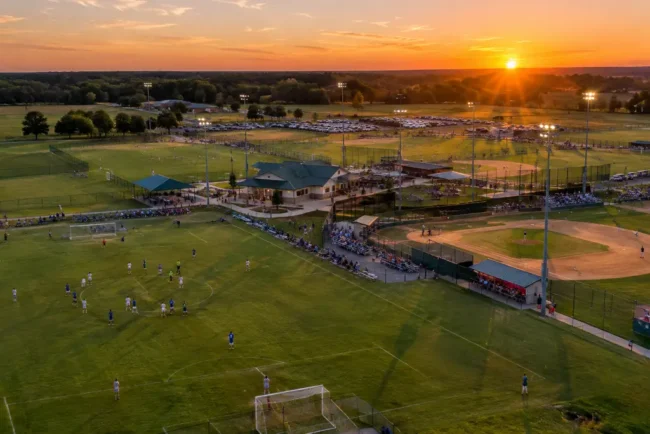
Comparable sports tourism data should be used carefully because facility size, market size, sport mix, and regional travel patterns differ. One useful reference is River City Sportsplex in Chesterfield County, Virginia. It is an outdoor 16-field, 115-acre complex that generated $56.7 million in sports tourism spending in Fiscal Year 2024, which ended June 30, 2024, along with $2.1 million in local tax revenue. It also accounted for about 70 percent of Chesterfield’s $79.3 million in sports tourism spending in that period, according to Midlothian Business reporting.
That benchmark is not a forecast for Aviston. River City is much larger, outdoors, and built around a different field inventory. Its value for Aviston is analytical: it shows how public agencies and local observers can measure sports tourism through spending, tax receipts, and share of regional tourism activity. Aviston’s smaller indoor venue would need its own scale-appropriate dashboard.
Why Tournament Intent Needs Calendar Evidence
The Aviston plan included an intention to host tournaments. Tournament activity can create short bursts of spending, especially if visiting teams stay long enough to eat, refuel, or lodge nearby. Yet the economic value depends on confirmed event calendars, team counts, visitor origin, and the number of days each event occupies the venue.
For indoor youth sports, tournaments may also affect local training access. A busy weekend event can help revenue and local merchants, but it may displace open gym time or team practices. The strongest facility model is not simply the one with the most event weekends. It is the one that balances outside visitors with local development needs.
Aviston Sportsplex Impact Indicators To Track
A Practical Scorecard For Aviston
The most useful way to evaluate the project after opening is a public-facing scorecard. It should be simple enough for residents to understand and specific enough for coaches, clubs, and local officials to use. The following indicators would give Aviston a clearer picture of sports value and economic value:
- Facility use: weekly hours booked by sport, age group, and user type.
- Access: number of local athletes served, open training hours, and beginner programming.
- Travel effects: reported reduction in trips to out-of-area indoor facilities.
- Events: tournament dates, teams entered, and share of visiting teams from outside Clinton County.
- Local spending: concession sales, event fees, and voluntary business surveys on tournament weekends.
- Community balance: percentage of prime-time slots used by local clubs versus outside rentals.
What A Cautious Reading Suggests
The verified facts support a modest but meaningful sports development case: a planned indoor complex in Aviston was designed to add courts, turf, cages, simulation tools, concessions, booking technology, and tournament capacity. Those features can improve training reliability and may support visitor spending. The evidence does not support a precise economic projection for Aviston based on the supplied research alone.
For community leaders, the best reading is disciplined optimism. The facility’s value will be proven through participation data, fair scheduling, tournament records, and local spending evidence. If the venue widens access for young athletes while bringing measured visitor activity into Clinton County, the Aviston Sportsplex impact will be more than a construction story. It will be a test of how a small community turns indoor sports infrastructure into durable youth development and accountable local benefit.