
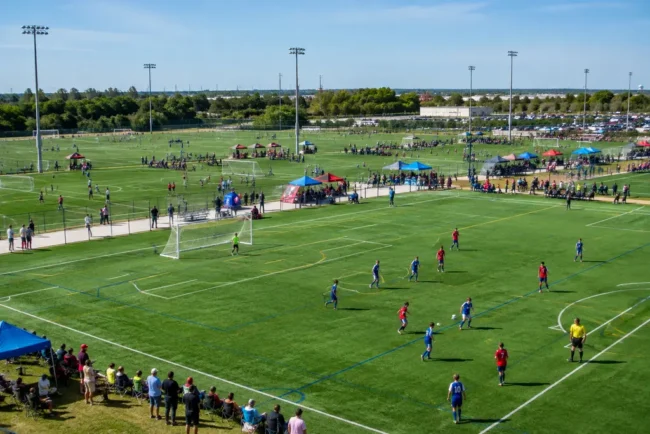
Ontario Sports Empire opened in Ontario, California, on October 24, 2026, giving youth sports organizers a large new site for practices, games and tournaments. The venue’s opening announcement listed a ribbon-cutting, youth clinics and live music for the public celebration, which ran from 10:30 a.m. to 4:00 p.m. The clinics put youth participation on the opening-day program, but a one-day event does not show whether more children will play regularly. That distinction matters: the opening added places to play, while sustained participation depends on who can use them, at what times and at what cost.
What Ontario Sports Empire Added
The venue describes a 190-acre complex with multipurpose fields, baseball and softball diamonds, and fields for football and rugby. For a baseball or softball organizer, several diamonds at one address make it possible to design a bracket with games running in parallel instead of sending teams to separate sites. A local league could use the same concentration of fields to group age divisions, provided the layouts match its rules. Those are practical advantages of the design, not evidence that either type of booking has already taken place.
The venue’s inventory uses labels that describe different things: some identify a sport, some describe field size and one identifies a championship designation. The opening materials do not establish that all five counts represent separate groups of surfaces, so adding the figures would risk counting a field twice. The figures are best read as a description of what the complex offers rather than a total of simultaneously bookable spaces. For clubs building a schedule, the next detail would be a field-by-field map that identifies which configurations can operate at the same time.
| Field Category Listed by the Venue | Reported Count |
|---|---|
| Multipurpose fields | 20 |
| Youth baseball and softball diamonds | 14 |
| Full-size diamonds | 8 |
| Football and rugby fields | 4 |
| Championship diamonds | 2 |
Matching Fields to Age Groups
The separate listings for youth and full-size diamonds matter because a field that fits one age group may not fit another without changes. A program moving players into older divisions would need to confirm the available base paths, pitching distances and setup time before assigning games. If a surface has to be reset between divisions, that work belongs in the schedule rather than in the next team’s warm-up window. The published inventory does not establish the dimensions or changeover arrangements for each diamond.
A championship field is useful for a final, but most teams in a bracket spend their time in earlier rounds. Their experience depends on whether warm-up periods are workable, game starts hold and delays on one diamond can be absorbed elsewhere. At Ontario Sports Empire, the number of fields makes that flexibility possible in principle; actual schedules and game logs would show whether organizers used it. Opening-day activities did not provide a basis for judging tournament turnaround or the number of teams the venue can handle at once.
Tournament Capacity and Local Field Time
A tournament schedule and a community league calendar put different demands on the same facility. A bracket needs blocks that remain available as teams advance, while a recreation league needs dependable assignments week after week. A complex with several field types can accommodate both only if bookings leave enough appropriate space at the hours each program can use. The relevant measure for a local club is not how many fields appear on the site plan, but how many suitable hours it can reserve across a full season.
Scheduling Ontario Sports Empire for Regular Play
A field can be open on paper and still be impractical for a youth program. An early weekday slot may be hard to reach after school, while a late slot may not work for younger players or volunteer coaches. A recurring booking at a workable hour lets a team set a practice routine and gives families time to arrange transport. Published allocations by day and time would tell local leagues more about access than a utilization figure that groups school-day hours with evening and weekend bookings.
Even a tournament that draws teams from outside the area can help local clubs if it replaces trips they would otherwise make. The benefit depends on whether those clubs qualify, can afford to enter and receive game times that make a same-day trip practical. A local venue does not automatically remove every expense, and the opening information supplies no comparison of what families paid before and after October 24, 2026. A useful follow-up would track the same teams’ travel distances and total out-of-pocket costs across comparable events.
Participant counts need similar care. A full weekend of games may reflect more fixtures for established travel teams rather than more children joining organized sport. To tell the difference, clubs would need to track unique participants, first-time registrations and whether those players returned for another session or season. That is the distinction in our coverage of community sports facilities and youth access: new space is one input, while repeat participation is one way to judge whether it served more players.
What the Investment Estimate Measures

Buying Sandlot’s pre-opening report put the project cost at about $850 million and described ONT Field, a 6,500-seat professional baseball stadium, as part of a development that included food, beverage and entertainment spaces. The headline cost therefore covers more than youth playing surfaces. Dividing that sum by the reported number of youth diamonds would not produce a meaningful cost per field. The materials do not give a separate youth-facility budget, so they cannot establish how much of the investment went directly toward youth play.
The same report cited a projected annual economic impact of $60 million to $70 million. That range was an estimate, not a record of spending collected since the grand opening. It covered activity associated with youth tournaments and professional baseball, along with visitor spending in areas such as dining and hospitality. Without a breakdown by activity, the projection does not show how much youth tournaments would contribute, and it says nothing about how affordable participation would be for families in Ontario.
Tourism and youth access can move in different directions even during the same event. A tournament can generate hotel stays from visiting teams while local families make day trips, or it can draw visitor spending without adding a new place for a beginner. To measure the first effect, the useful distinction is spending tied to the event rather than all spending near the venue that weekend. To measure the second, the useful distinction is between children who joined a program and players who were already competing elsewhere.
For a tournament operator, reservations and gate activity might help describe a busy weekend, but they would not reveal whether teams received the playing time promised in the format. For a community program, cost per session and the reliability of practice bookings are more relevant than spectator volume. These are different questions about the same investment, and each needs its own reporting. Exploring more details about these aspects can be seen at Back2Tap, a related site in the same network, which offers a separate reading destination; the project figures here come from the venue announcement and pre-opening reporting.
How to Judge Youth Access in Ontario
The opening-day clinics showed how the venue could introduce children to organized activity, but the next step for a first-time player is a place in a regular program. A meaningful follow-up would distinguish clinic attendance from later league or lesson registration, then check how many of those registrants returned. A waitlist can also be informative if it is tracked by age group and time slot, since an opening in one division does not solve a shortage in another. The available research does not supply those records.
Affordability should be assessed at the family level rather than inferred from a field rental rate alone. For a baseball or softball family, the relevant cost might include registration, equipment and transport; for a tournament team, entry charges and overnight travel may also matter. Those are costs to check, not fees confirmed for this venue. Comparing what a family pays for the full schedule, and what support is available if it cannot pay, would show more than an advertised starting price.
Access also includes what happens between arrival and the start of play. A family may need a workable route from drop-off to the assigned field, and a coach may need enough time and space to prepare players before a game. Those details are especially relevant at a 190-acre site, where the location of a field matters as much as its presence on the map. The research does not establish how those arrangements worked for families using different parts of the complex after opening day.
As of November 24, 2026, the documented change was that Ontario Sports Empire had opened a substantial inventory of playing spaces and included youth clinics in its public launch. The available material does not establish that local participation rose in the month that followed. A credible assessment would pair the booking calendar with club registration and retention records, separating new players from those transferring from another venue. That evidence would show whether the opening changed who got to play, not just where existing teams played.