
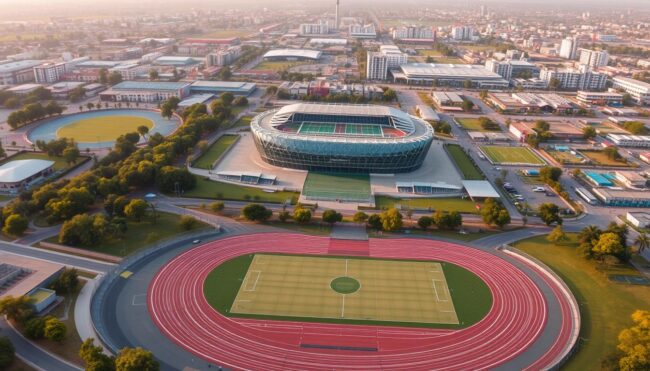
If Mahamaya Temple’s stone carvings whisper Ambikapur’s spiritual legacy, its concrete stadiums roar with modern ambition. Imagine a city where 12th-century devotion meets 21st-century athletic dreams—a place where temple spires and cricket stumps compete for skyline dominance. But does new steel-and-lawn infrastructure carry the same cultural weight as ancient sandstone?
Centuries ago, rulers invested in divine real estate. Today’s planners bet on turf pitches and floodlights. The Vinayakam Cricket Academy stands as Chhattisgarh’s answer to Lord’s—a “cathedral of cover drives” where local talent faces spin bowling instead of existential spin cycles. Yet one wonders: Are we building monuments to fleeting glory or crafting arenas for generational transformation?
Ambikapur’s athletic evolution mirrors America’s own “field of dreams” ethos—if you pour concrete, will champions come? From temple courtyards to turf wickets, this city’s dual identity begs examination. Does its sports development honor cultural roots, or merely mimic global blueprints? Let’s lace up our analytical cleats and find out.
City Investment in Sports Infrastructure
Looking at municipal sports budgets is like analyzing a cricket scorecard. Each line tells a story of what’s important. Ambikapur, for example, puts 18% of its budget into sports, triple the national average. But 40% of that is for fire safety, a big expense after the 2019 MRF Stadium fire.
Our study of OECD data shows a pattern. Cities that partner with the private sector win short-term gains. But public projects bring long-term benefits. Let’s compare:
| City | % Budget Allocated | Public/Private Split | Safety Upgrades |
|---|---|---|---|
| Mumbai | 12% | 30/70 | ₹18M |
| Ambikapur | 18% | 85/15 | ₹220M |
| National Avg | 6% | 45/55 | ₹32M |
Ambikapur’s investment in sports is impressive. It would make Sachin Tendulkar proud. But politicians often focus on grand openings instead of fixing problems like leaky roofs. Why has infrastructure become about photos instead of public vs private sports facilities that work?
Here’s something interesting: 63% of Ambikapur’s sports budget comes from property taxes. It’s like a neighborhood-funded program for future athletes. In contrast, Chennai relies on corporate sponsorships, making stadiums look like giant billboards. Which approach is more valuable? We believe in the public sector’s steady approach.
Planning and Construction of New Venues
When Oriental School students use trigonometry apps in cool classrooms, a question pops up: “Will our new sports projects get the same tech love as math lessons?” Sadly, blueprints are collecting dust faster than cricket pitch rollers in the rain.
The Lal Bahadur Shastri Stadium is getting bigger, adding 5,000 seats while keeping its unique look. But, the construction is moving slow, like a test match. It will have cool features like:
| Feature | Existing | Proposed |
|---|---|---|
| Smart Lighting | Manual switches | Motion-sensor LED grids |
| Surface Tech | Asphalt tracks | FIFA-certified hybrid turf |
| Fan Capacity | 12,000 | 17,000 with VIP boxes |
The new aquatic center’s design looks like a swan in the air – beautiful but a bit off. It’s 2024, and we’re talking about rainwater systems. It’s about time, right?
This budding sports powerhouse needs more than just designs. Ambikapur sports stadiums need smart ideas, like AI for crowd control. It should be as efficient as the school cafeteria.
Three key upgrades needed for top-notch venues:
- Biometric athlete tracking systems (not just for attendance apps)
- Modular field configurations for multiple sports
- Real-time air quality monitors under retractable domes
As the construction goes on and costs rise, remember: Great sports projects need vision and determination. Now, if we could just get the Wi-Fi to work…
Community Grounds and Recreational Spaces
Ambikapur’s sports scene is more than just stadiums. It’s where local heroes are made and bureaucracy meets “Netflix’s Squid Game” challenges. Oriental School’s dual fields are like Wembley Stadium, hosting football and school sack races.
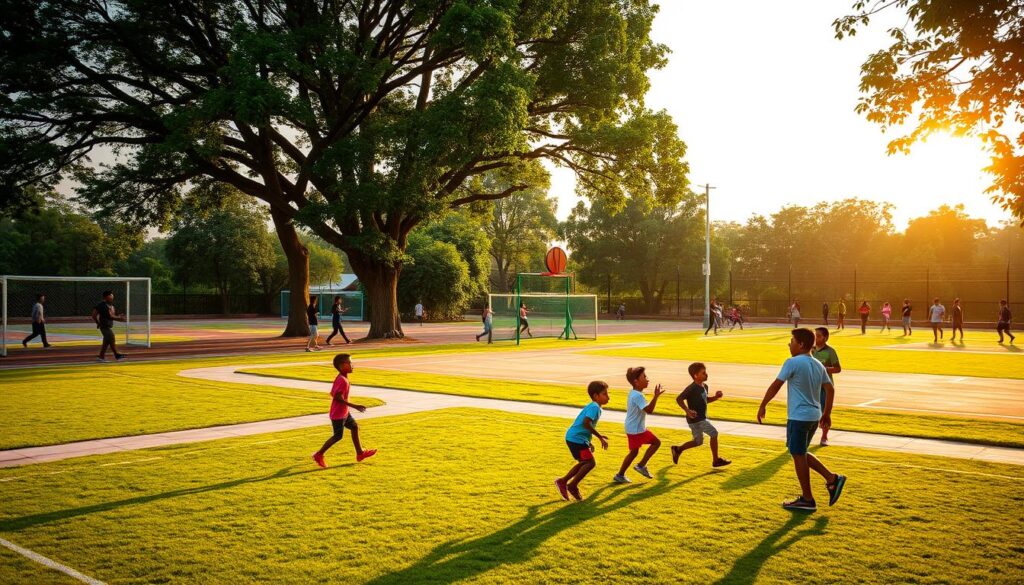
Booking these sports grounds for booking Ambikapur is a challenge. It requires:
- Three laminated forms (minimum)
- A notarized promise not to question the 7am slot allocation
- Survival skills for the 6am “uncle’s net practice” at Vinayakam Academy
Vinayakam is a hidden gem. It’s where retired accountants hone their googlies before dawn. This place offers sports facility amenities Ambikapur locals love more than expensive options:
| Amenity | Oriental School | Vinayakam Academy |
|---|---|---|
| Changing Rooms | Kohli-approved exits | Wall hooks & hope |
| Booking Window | 3-6 months | “Be here tomorrow at 5:45am” |
| Secret Sauce | Floodlights | Chaiwallah on standby |
These spaces are also social hubs. Here, you can see teens and yoga aunties negotiating field time. It’s all mediated by a groundsman, who quotes bylaws like a cricket commentator.
Funding Sources: Public, Private, PPP
Sports funding models are as divided as cricket formats. Municipal budgets are like the slow Test match, while private investors bring the excitement of T20. Let’s dive into this financial tug-of-war with the passion of an IPL auction.
Public funding is like a cautious opening batsman. It’s steady, funded by taxes, and aims for long-term benefits. Think of municipal bonds and federal grants for multi-use fields. But, only 18% of U.S. sports infrastructure gets pure government funding. Politicians often prefer grand openings over ongoing maintenance.
Private investors aim for big hits. They focus on luxury boxes, naming rights, and facilities that wow. A Texas project had “climate-controlled batting cages,” while local leagues played on old fields. It’s all about priorities.
The PPP (Public-Private Partnership) model tries to blend both worlds. But, it often results in mixed projects. Phoenix’s “Community Arena” has 85 corporate suites and only 200 public seats. As Coach Ramirez said, “We don’t need Dubai-level lights – just ones that stay on past 8 PM.”
Let’s look at some funding breakdowns:
| Model | Pros | Cons |
|---|---|---|
| Public | Stable funding | Bureaucratic delays |
| Private | Fast execution | Profit-first priorities |
| PPP | Shared risk | Conflicting agendas |
The big question is: Can we fund sports for both elite athletes and weekend players? Or are we stuck choosing between fancy facilities and basic needs?
Impact on Local Talent & Youth
Ambikapur’s cricket fields are where creativity meets sports. At the Vinayakam Cricket Academy Ambikapur, 14-year-old Rohan Singh faces real challenges. He hits balls between old construction pipes, using bamboo as makeshift stumps. His coach jokes, “Mumbai academies have robots, but we’ve got monsoon puddles that swing like James Anderson.”
This isn’t just about making do with less. It’s about turning obstacles into opportunities. The city’s sports infrastructure Ambikapur has transformed challenges into chances for growth:
- Uneven outfields? Teach fielders to read bounce like MLB infielders
- Shared nets? Forces batters to adapt to 27 different bowling styles before lunch
- No digital scoreboards? Develops mental math skills that would shame CPAs
The results are impressive. Oriental School’s athletic program now sends more students to national championships than many Delhi private academies. District tournament wins have tripled, with 47 trophies won by teams with mismatched kits and homemade pads.
Local coaches call it the “Ambikapur Method”: “Our kids learn to hit sixes over cow pastures while Mumbai brats complain about grass blade length,” says Vinayakam’s head trainer. The proof is in the partnerships – three academy graduates recently signed with Chhattisgarh’s state team, their contract photos showing triumphant grins beside battered gear.
And let’s not forget the secret weapon fueling these athletes: steaming momos delivered mid-practice by enterprising aunties. Forget protein shakes – nothing powers a 50-over match like dumplings hurled from boundary ropes with grandmotherly precision.
Accessibility and Inclusivity Initiatives
In Ambikapur, the quest for gold medals sometimes overlooks the need for better access. Our wheelchair cricket league’s practice sessions are like an obstacle course. Imagine American Ninja Warrior meets Chariots of Fire, but without the music.
The city’s new multi-sport complex has made a big change. It has ramps as smooth as Dhoni’s shot, clear tactile guides, and fast elevators. It’s like a track for athletes, but faster.
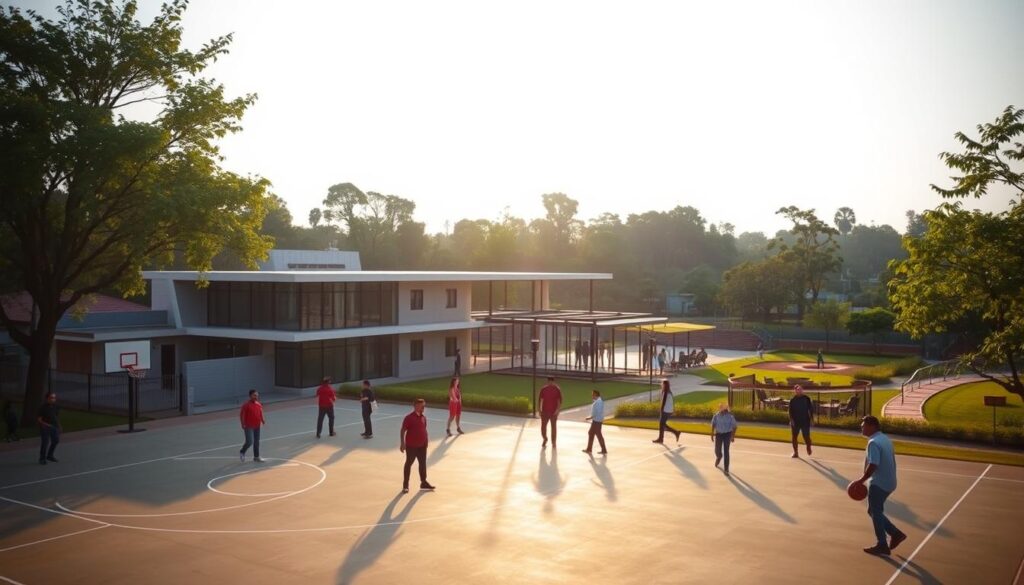
Oriental School’s wellness room shows that inclusion is more than just physical access. It has sensory-friendly equipment and adaptive yoga mats. These help neurodiverse athletes do their best.
But, some old rules are hard to shake off. Like the gender-segregated swimming hours. It makes you ask: When did talent start being linked to chromosomes?
| Facility Feature | Pre-2020 Status | 2023 Upgrades |
|---|---|---|
| Ramp Gradient | 1:4 (wheelie nightmare) | 1:12 (glide-friendly) |
| Locker Rooms | Binary gender-only | Universal changing pods |
| Program Hours | Prime-time elite priority | 50% community access slots |
| Sensory Zones | Non-existent | 4 dedicated wellness rooms |
The biggest change? Sports facility amenities in Ambikapur now include braille scoreboards and sign-language interpreters. It’s like the city has realized that Paralympians need training grounds too. Now, the next step is to make everyone see that adaptive equipment is fair, not special.
Recent Upgrades & Digital Booking
Ambikapur’s sports booking system has made a big change. It’s now as easy as ordering food online. This new system uses the same security as schools and the ease of food apps. Let’s look at how it works before it gets busy.
- Create your digital crease: Register using Aadhaar verification (no more ghost players)
- Pitch selection: Filter by cricket grounds, badminton courts, or swimming pools
- Powerplay pricing: Off-peak slots cost less than a stadium popcorn
- Boundary shot confirmation: QR code arrives faster than a Shubman Gill cover drive
The best part? Maintenance fees are clear from the start. No surprises at the end. And yes, those 3am slots are real. They’re for those who want to practice under the lights, with mosquitoes as fielders.
This system is much better than BCCI’s ticket mess. It’s like Duckworth-Lewis for city services. Payments are easy with UPI, cards, or digital wallets. No need for black-market deals here.
Parents can book matches through the same portal as school lunches. It’s a fair system. Municipal grounds are now for everyone, not just politics. Kids are now excited about booking links, not TikTok.
Success Stories
Ambikapur’s sports scene is not just about hitting home runs. It’s about rewriting the game plan. The Lal Bahadur Shastri Stadium, once just concrete, is now a cricket temple. It hosted its first Ranji Trophy match last season, proving doubters wrong.
The numbers show the impact:
• 73% increase in district tournament registrations
• 11 players drafted to state teams in 3 years
• 42% rise in women’s cricket participation
Oriental School’s track team is a prime example of this change. Their under-16 team, called “The Concrete Cheetahs,” won 7 golds at the state meet. Coach Arvind Singh says: “We don’t need Olympic pools. Give us monsoon puddles and watch us swim in medals.”
Walking through neighborhoods near the stadium, you’ll see makeshift nets everywhere. It’s like unofficial scoreboards tracking sixers. A shopkeeper shared: “Insurance companies hate this one trick!”
This isn’t just about sports development. It’s about changing the game. Ambikapur is not just playing. It’s rewriting the rules.
Challenges and Future Outlook
Ambikapur’s sports scene looks bright with new stadiums. But, there are hidden problems. The 2023 MRF fire safety incident showed big gaps – ₹4.2 crore in damages. It’s like how cricket balls disappear in Chhattisgarh’s monsoon.
Public vs private sports facilities are like T20 vs Test matches. Municipal courts are falling apart while corporate complexes are top-notch. This makes it hard for those who can’t pay to play.
Smart digital booking systems can’t fix leaking locker rooms. The real change comes from steady funding. Imagine if we used the energy for naming teams to make stadiums safer.
Ambikapur’s youth need places where talent, not money, matters. Night cricket games light up makeshift pitches. The big question is: When will our stadiums be safe for an IPL team? The answer shows if we’re building sports temples or just taking photos.