
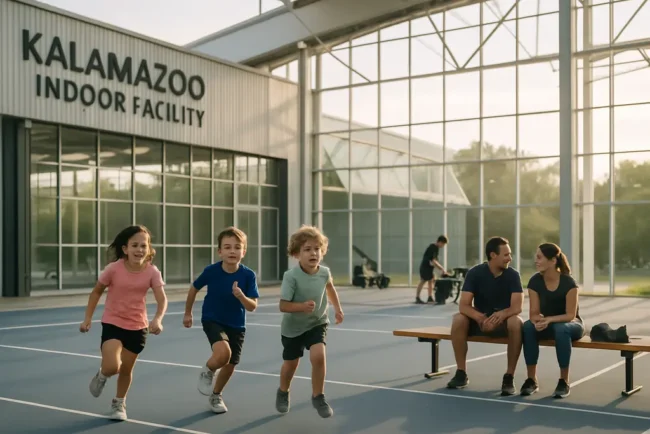
The Kalamazoo Indoor Facility has moved from planning to construction, but its grand opening remains a future milestone. The project broke ground on July 31, 2026, and the reported target is an October 2027 opening, after construction planned through fall 2027. For youth sports in Kalamazoo County, the facility is best read as an access project first and a tournament-economy project second: its success will depend on how well weekday community use and weekend regional events can share the same building.
Kalamazoo Indoor Facility Site And Timeline
Groundbreaking And Opening Target
The project reached a formal checkpoint on July 31, 2026, when officials held the groundbreaking for the indoor youth sports venue. The reported schedule calls for construction to finish in fall 2027, with an October 2027 opening target. The planned facility is about 140,000 square feet and is expected to include eight full-size basketball courts that can convert into 16 volleyball courts, a 200-by-85-foot indoor turf field, flex and team rooms, a lobby, ticketing space, and a café area with food and beverage seating, according to WHTC coverage.
Those dates matter because indoor youth sports calendars are planned months in advance. Basketball and volleyball tournaments need court blocks, staffing plans, team registration windows, officials, and lodging coordination. A target opening in October 2027 places the venue after the start of many fall school calendars, so early programming may need to be phased rather than assumed to start at full volume on day one. That is not a weakness in the plan; it is a normal constraint for a venue entering a crowded youth sports schedule.
Site Choice And Regional Access
The Westgate Drive site was selected from more than 30 reviewed locations. The county described it as part of a 123-acre parcel, with 20 acres allocated for the facility, and cited accessibility, future expansion potential, and proximity to major infrastructure in the selection process through the county announcement on the Westgate site decision. Its location near major road connections is relevant for a tournament venue because weekend traffic patterns involve visiting teams, parents, officials, and vendors arriving in compressed waves.
For local sports users, the site decision also affects practical access. A facility can have strong court capacity on paper, but travel time, parking flow, and weekday scheduling shape whether schools, youth leagues, and residents use it regularly. The county plan identifies weekday use for local youth leagues, schools, and residents, while weekends are intended for regional tournaments. That split is logical for revenue and community programming, though it will require firm scheduling policies if demand is high.
Court Mix And Weekday Access
Kalamazoo Indoor Facility Layout
The court mix points to a venue built around basketball and volleyball, with the turf field broadening the user base. Eight full-size basketball courts give tournament operators the ability to run multiple age groups or divisions in one location. The conversion to 16 volleyball courts is significant because volleyball tournaments often require many simultaneous matches and predictable warmup space. The turf field creates room for sports or training formats that do not fit a court-only building.
The Kalamazoo Indoor Facility should be evaluated through daily use, not just opening-week attention. A 140,000-square-foot venue can become a high-value public sports asset if weekday hours serve local teams that struggle to find indoor space. In Michigan, indoor access is especially relevant during colder months, when outdoor fields and informal training options narrow. The research provided does not include a finalized public rate card, booking policy, or school-use schedule, so any claim about affordability would be premature.
Why Indoor Capacity Matters For Youth Teams
Youth sports participation is shaped by more than coaching and interest. Facility access affects practice frequency, team formation, and whether younger athletes can receive consistent instruction. A lack of indoor courts can force leagues into late-night slots, fragmented locations, or shortened sessions. Those conditions tend to place the heaviest burden on families with limited transportation flexibility.
The planned weekday community use is the strongest youth-development argument for the project. If schools and local leagues receive predictable access, the building could reduce pressure on existing gyms and give coaches more reliable practice blocks. As outlined in related community recreation coverage from Back2Tap, facility access is often part of a larger discussion about how families use sports spaces across a region.
Economic Case And Tournament Demand

Hotel Assessment Funding
The financing model is notable because the reported $45 million to $49 million investment is tied to a 4% assessment on hotel stays under 30 days in Kalamazoo County, approved by hotel operators. The reporting states that the structure does not place the cost on general taxpayers. That distinction matters in sports infrastructure because public funding debates often turn on who pays, who benefits, and whether projected visitor spending materializes.
The Kalamazoo Indoor Facility is projected to generate about $48 million to $50 million per year in economic activity, drive 36,000 hotel room nights annually, and create hundreds of jobs. Those figures should be treated as projections until the venue has several full tournament cycles in operation. Sports tourism estimates can be affected by event mix, repeat bookings, hotel availability, fuel costs, and competition from similar venues in nearby markets.
Tournament Scheduling And Community Tradeoffs
Weekend tournaments can bring outside spending into restaurants, hotels, retail stores, and fuel stations. They can also compress parking, increase traffic near the site, and reduce weekend access for local recreational users if booking rules favor large events. The stated weekday-weekend split is a practical response: local leagues and schools use the venue during the week, while regional tournaments use the building on weekends.
The tradeoff is not unusual in youth sports facilities. Tournament revenue often helps support operations, but community credibility depends on local athletes seeing regular benefits. A balanced calendar would need to protect enough local hours for developmental programming while still attracting regional events that fill the building.
- Access measure: how many weekday court and turf hours are available to local youth leagues, schools, and residents.
- Sports measure: whether basketball, volleyball, and turf users all receive workable scheduling windows.
- Economic measure: whether room-night and visitor-spending projections hold after the first full year of tournament operations.
- Community measure: whether fees, travel time, and booking rules support broad participation rather than only high-volume events.
Kalamazoo Indoor Facility And Youth Access
What To Watch Before October 2027
Before the targeted October 2027 opening, the most useful information will be operational rather than ceremonial. Families, coaches, and school administrators will need booking rules, cost structures, sport-by-sport scheduling priorities, and details on how local programs can secure time. Those items are not included in the research provided, so they should not be assumed.
The project has a clear facility logic: Kalamazoo County is building indoor court and turf capacity that can serve local youth athletes during the week and host regional tournaments on weekends. The risks are equally clear. If tournament demand dominates the calendar, community access could feel secondary. If pricing or transportation becomes a barrier, the benefits may be uneven. If scheduling is balanced and transparent, the Kalamazoo Indoor Facility could become a meaningful addition to youth sports infrastructure in the county after it opens in October 2027.