
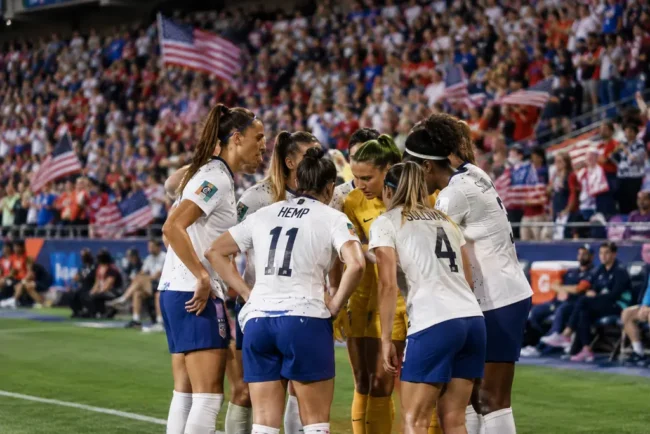
USWNT November Fixtures arrive with a direct development question for women’s soccer in the United States: can a national-team program use high-stakes qualification matches to test depth while still protecting tournament standards? As of November 16, 2026, the next confirmed competitive marker is the November 27, 2026 quarterfinal against El Salvador in the 2026 CONCACAF W Championship, where a U.S. win would secure direct qualification for the 2027 FIFA Women’s World Cup, according to Netflix Tudum’s qualification guide.
The match is not just a senior-team checkpoint. For clubs, youth coaches, regional scouts, and player-development staff, it is a practical case study in how the top of the pyramid influences the base. Selection choices, substitution patterns, tactical adjustments, and player roles in November can shape how younger players see the route from club soccer into the national-team environment.
USWNT November Fixtures And Qualification Stakes
The 2026 CONCACAF W Championship is scheduled from November 27 to December 5, 2026, and it serves as the regional qualifying tournament for both the 2027 Women’s World Cup and the 2028 Los Angeles Olympics. CONCACAF has also stated that the United States entered this tournament with a dominant historical record in the competition: 35 wins, no losses, one draw, and five goals conceded across 36 previous matches, as detailed in CONCACAF’s USA team profile.
Why USWNT November Fixtures Matter For Qualification
The quarterfinal format gives the November 27 match a direct development edge. A win over El Salvador would move the United States into the semifinal round and secure a direct World Cup berth. That kind of match can clarify which players are trusted in pressure situations, not only which players perform in lower-stakes friendlies.
If the United States loses the quarterfinal, the research indicates there remains a route through play-in matches on December 2, 2026, and potentially through the 2027 intercontinental Play-Off Tournament. That safety net matters, but it does not remove the performance demand. In a development sense, knockout pressure exposes decision-making, defensive concentration, and emotional control more sharply than a friendly match can.
Stakes Beyond One Result
The United States has already qualified for the 2028 Los Angeles Olympics as host, which changes part of the competitive equation. The Olympic place does not depend on this tournament for the U.S., but the W Championship still carries regional standing, World Cup qualification, and squad-building value. For a team trying to refresh its player pool under Emma Hayes, that combination is useful: the matches are meaningful, but the staff can still measure which players are ready for repeated tournament demands.
For grassroots programs, the lesson is clear. Player development cannot be judged only through technical drills or domestic club form. The national-team level asks whether players can process risk, spacing, tempo, and game state under consequence. Those are trainable habits, and the November match environment gives coaches a visible model to discuss with young players.
Roster Development Signals From October Tests
The October 2026 matches against Spain gave useful context before qualification. The United States lost 2-0 on October 10 and drew 2-2 on October 13, 2026. The results were not tournament results, but they did provide a competitive test against an elite opponent before the CONCACAF W Championship. For readers tracking selection patterns, our related USWNT roster analysis after Spain camp offers a closer look at the camp’s development signals.
Younger Players In Real Evaluation Windows
Hayes used the Spain window to introduce or involve less-experienced players such as Jordan Silkowitz, Evelyn Shores, Trinity Byars, and Pietra Tordin. The research also states that in Hayes’ first 32 matches in charge, 32 different players earned their first caps. That number points to a deliberate widening of the player pool rather than a short-term reliance on an established group.
This is where USWNT November Fixtures become more than a senior-team storyline. When younger or less-capped players are brought near a qualifier, the pathway becomes more visible for college programs, NWSL clubs, youth academies, and community coaches. It shows that the route upward is not closed, but it also sets a higher bar: opportunity must be matched by tactical reliability and repeatable habits.
Lessons For Knockout Preparation
The Spain results also support a cautious reading. A defeat and a draw do not prove readiness or weakness on their own. They do show that Hayes’ staff used elite friendlies to test resilience, depth, and mental preparation before a knockout-style regional tournament. That approach is consistent with long-term development because it places players in demanding roles before qualification pressure peaks.
From a coaching perspective, the most relevant details are not only goals scored or conceded. Coaches at club and youth levels can study how players respond after losing possession, whether midfielders offer passing angles under pressure, how fullbacks manage transition moments, and how forwards press after long defensive sequences. These are the habits that connect community coaching with international football.
Community And Club Development Implications

The national team’s November schedule should also be viewed through the structure of the CONCACAF cycle. The 2026 competition is the first of three major centralized women’s national-team competitions in the confederation’s 2025-2029 cycle. A more consistent calendar can help player-development planning because clubs and federations can build toward known competitive windows.
Clearer Pathways For Youth Coaches
For youth coaches, clarity matters. When qualification tournaments are scheduled and visible, coaches can build learning moments around them. A U-15 or U-17 team can review pressing triggers, rest-defense positioning, or set-piece organization from senior international matches. The practical value is not in copying the national team exactly, but in translating match principles into age-appropriate coaching points.
The USWNT November Fixtures also give clubs a way to connect aspiration with evidence. Young players often hear broad messages about working hard or staying ready. A qualifier gives them a more concrete reference: selection depends on technical quality, but also on decision speed, defensive discipline, and the ability to handle a match that changes quickly.
Local Engagement Around National-Team Matches
Community engagement can grow when national-team matches are used as shared learning events. Clubs can host film sessions, coaches can assign observation tasks, and families can discuss what players do away from the ball. For smaller clubs, directories and local-network tools such as a related community directory can help people find nearby programs, facilities, and soccer activities connected to broader participation goals.
The key is to keep the match discussion practical. Instead of treating the November match only as a win-or-loss event, clubs can ask players to track one role for 15 minutes: the holding midfielder’s body shape, the goalkeeper’s distribution choices, or the timing of runs behind the back line. Those details turn a senior international fixture into a coaching resource.
USWNT November Fixtures And The U.S. Development Pipeline
The strongest development value in USWNT November Fixtures is the link between pressure and opportunity. The United States has a strong historical record in the CONCACAF W Championship, but the current cycle is also about renewing depth under a coach who has already broadened the cap base. That balance is not simple. A national team must qualify first, but the process of qualification can still reveal which players are ready to carry responsibility.
For women’s soccer development in the United States, the November 27 match against El Salvador should be assessed on three levels. First, the result matters because direct World Cup qualification is attached to it. Second, the lineup and in-game choices matter because they show how much trust newer players have earned. Third, the wider tournament calendar matters because consistent high-level competition gives clubs and coaches clearer targets for preparing players.
The evidence available before the tournament points to a U.S. program trying to protect its competitive standard while expanding the player pool. That is the right tension for a mature development system. If the pathway is too narrow, promising players wait too long. If it is too loose, tournament performance can suffer. The November fixtures will not answer every question, but they will offer a meaningful snapshot of how national-team pressure, club preparation, and grassroots ambition are connecting in the current cycle.