
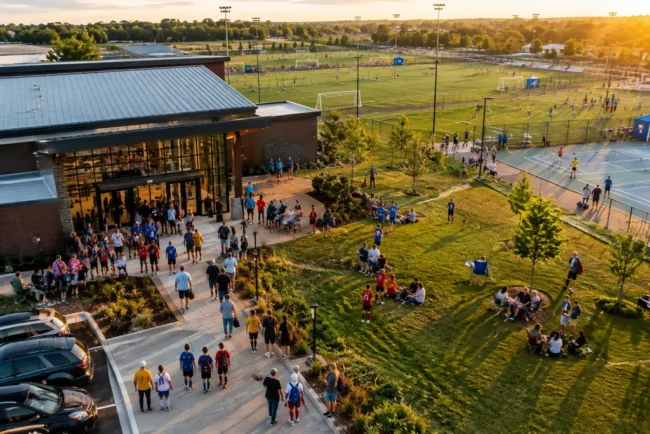
The Forge Athletic Complex moved from concept to construction after its September 2026 groundbreaking in South Lubbock, Texas. For youth basketball and volleyball families, the key question is not only whether a new indoor venue adds court space, but whether that space becomes usable for school-age athletes across income levels, club tiers, and weekly schedules.
Forge Athletic Complex Project Baseline
The project is being built near 104th Street and Milwaukee Avenue in South Lubbock, according to the research record. It is described as a privately funded indoor sports facility of about 63,000 square feet, with a configuration that can support six full-size basketball courts or nine volleyball courts. That scale matters in a market where indoor court supply can limit practice slots, tournament dates, and off-season development time.
Forge Athletic Complex Timing And Scale
The state project record lists an estimated cost of about $7.78 million and a projected completion date of September 15, 2027, in the Texas project filing. The research notes also reference a public opening target of July to early August 2027, so readers should treat the earlier date as an operating target and the state filing date as the documented construction timeline. For club directors and tournament planners, that distinction is practical: scheduling commitments usually need contingency windows when construction and inspections are still ahead.
Court Supply For Basketball And Volleyball
For the Forge Athletic Complex, that scale is most relevant to basketball and volleyball because both sports depend on repeated indoor court access. A six-court basketball setup can reduce compression in weekend events, while nine volleyball courts can support pool-play formats with fewer long gaps between matches. The facility also has a weekday and weekend split in its stated use pattern: training, camps, and community access during the week, with larger tournaments and events on weekends. That model can work well if weekday pricing and time slots are not dominated only by elite teams.
Youth Sports Demand In Texas
Texas has room for growth in organized youth sports participation. In 2023–2024, national participation among youth ages 6–17 in organized sports teams or lessons outside school was 56.7%, while Texas was reported at 51.0%; the same data show a major income gap, with participation around 36.7% for children below the poverty threshold and 74.1% for those in the highest-income households, according to youth sports participation data. Those numbers are central to any facility analysis in Lubbock because new construction alone does not automatically close participation gaps.
Why Indoor Access Changes The Development Calendar
Indoor courts reduce exposure to weather interruptions and allow coaches to plan skill blocks with more consistency. For basketball, that can mean shooting repetition, small-sided decision work, and position-specific training outside the school season. For volleyball, it can mean more predictable serving, passing, and rotation work. In both sports, the value of a new venue depends on the number of available hours that reach beginners, recreational players, and middle-school athletes, not only travel-team rosters.
Texas Participation Gaps Remain A Caution
The Texas participation figure in the research record sits below the national rate, and the income split shows why access policy should be part of the facility conversation from the start. If court rentals, club dues, tournament entry fees, and travel costs rise together, families already outside organized sports may remain outside. A facility can create capacity, but coaching pipelines, fee structures, and transportation options often decide who uses that capacity.
Tournament Use And Club Capacity
The research notes describe the project as a year-round tournament venue with regional ambitions. That matters for Lubbock because tournaments can bring visiting teams, create stronger local competition, and give clubs more reasons to keep events inside West Texas rather than sending families across the state. The sports-business case is clear enough: concentrated courts under one roof make event operations easier than scattered gym sites.
Regional Events Need Local Coaching Depth
More events can sharpen local players only if clubs and community programs can meet the extra demand. A larger venue may encourage new teams, but those teams require trained coaches, court monitors, officials, medical planning, and clear child-safety procedures. From a grassroots development view, the strongest facility outcomes usually come when venue operators coordinate with schools, recreation departments, and local clubs rather than treating tournaments as the only measure of success.
Scheduling Is A Competitive Asset
For basketball and volleyball clubs, schedule reliability is often as valuable as square footage. Consistent weekday practice windows help coaches plan season cycles and reduce late-night sessions for younger athletes. Weekend tournament design also affects player welfare: court density is helpful, but event operators still need sensible match spacing, warm-up areas, hydration access, and recovery time. These details influence retention, particularly for athletes who are still deciding whether organized sport fits their family routine.
Affordability And Access Conditions

The facility’s community effect will depend on how access is structured. A privately funded venue can bring speed and capital discipline, yet public benefit is usually strongest when there are entry points for players who are not already embedded in club systems. That can include introductory clinics, low-cost camp sessions, school partnerships, and reserved community hours.
What Clubs Should Track
Local clubs and facility managers can avoid vague claims by tracking a few practical indicators once the venue opens:
- Participation mix: first-time players, returning players, recreational athletes, and travel-team athletes.
- Access cost: court rental rates, camp fees, team dues, and scholarship usage.
- Schedule reach: after-school slots, weekend entry-level programming, and age-group balance.
- Retention: how many players continue after their first camp, league, or training block.
This is where facility analysis connects directly to coaching practice. A venue can add supply, but player development depends on regular touches, qualified instruction, and a path that does not price out new families after the first session. For a related facilities lens, Ambikapur City has also examined how community sports facilities affect youth access when pricing, safety, and scheduling align. Broader community-venue coverage in this publishing network also includes the Bass Lake Roadhouse, another interesting site that offers insights into regional sports facility impacts.
Why Community Use Cannot Be An Afterthought
If a venue becomes tournament-heavy without enough weekday community programming, it may succeed commercially while having a narrower local development effect. Lubbock’s opportunity is to use the new court supply to widen the base: younger athletes, first-generation club families, and players who need local options before committing to travel schedules. That is the difference between a venue that hosts games and one that strengthens the athlete pathway.
Forge Athletic Complex Access Test
If the Forge Athletic Complex pairs its court capacity with affordable entry points, clear scheduling, and partnerships beyond the club circuit, it could become a meaningful youth sports asset for Lubbock and West Texas. The documented participation gap in Texas makes that access question central. The groundbreaking in September 2026 was an early milestone; the more useful evaluation will come after the venue opens, when participation data, court usage, event mix, and affordability can be measured against the promise of expanded youth basketball and volleyball opportunity.