
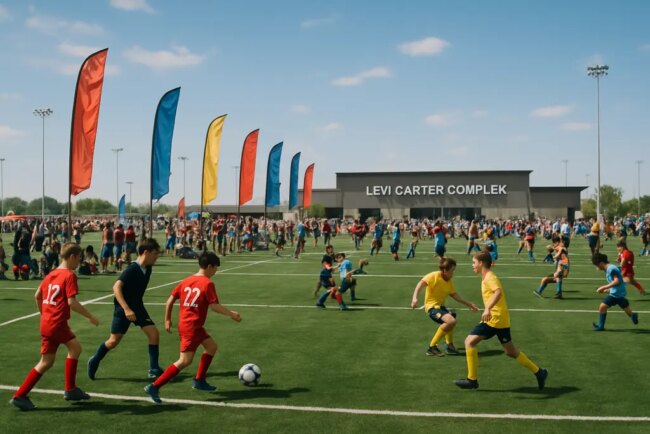
The Levi Carter Complex is approaching a key handover point for Omaha youth sports. As of September 21, 2026, the facility was still not open, but construction was reported near completion in mid-2026, with substantial completion expected in October 2026 and an opening planned for Fall 2026. The project is significant because its scale, court count, outdoor fields, and park setting could change how Omaha schedules basketball, volleyball, soccer, and multi-sport youth tournaments.
Levi Carter Complex Tournament Capacity
The project is being built in Levi Carter Park in Omaha as an approximately 115,000-square-foot activity and sports facility. Reporting in July 2026 described the project as a fully grant-funded, estimated $45 million development and noted that it was intended to be the largest indoor hard court facility in Omaha, with construction nearing completion at that stage, according to WOWT reporting.
Why Levi Carter Complex Matters For Scheduling
For tournament directors, the most direct change is simultaneous play. Indoor amenities are planned to include 10 basketball courts, which can be converted into 14 volleyball courts. The facility plan also includes a wrestling room, fitness room, computer lab, classrooms, and spaces for telehealth, while outdoor elements include four full-size synthetic turf soccer fields, picnic shelters, surface parking, walking trails, and a grand lawn, as described by Schemmer’s project notice.
That combination matters because Omaha tournament formats often depend on court supply, field supply, and the distance between venues. A 10-court basketball setup can allow brackets, pool play, consolation games, and younger age divisions to stay in one building. A 14-court volleyball conversion creates a different operational profile, with more matches running at the same time and fewer gaps between waves. If managed well, that can reduce split-site assignments that force families to move across town between matches.
Indoor And Outdoor Use Cases
The indoor courts should be most relevant to basketball and volleyball, while the synthetic turf fields give organizers a clearer route for soccer and other field-sport scheduling. The research notes support the presence of four full-size synthetic turf soccer fields, but they do not provide a detailed annual utilization forecast. For that reason, any estimate of total event volume after opening should be treated as uncertain until the operator releases a schedule or annual booking data.
The Levi Carter Complex also appears designed for more than weekend brackets. Classrooms, a computer lab, fitness areas, and telehealth spaces can support coaching meetings, athlete check-ins, training sessions, and welfare needs during longer events. These spaces do not guarantee better tournament delivery by themselves. Their value depends on staffing, reservation rules, medical protocols, Wi-Fi capacity, and how the venue separates athlete, spectator, and administrative movement during peak sessions.
Early Tournament Signals For Omaha
The early event calendar identified in the research points to a quick test of the venue after the planned Fall 2026 opening. One listed event is NE Attack’s NO ZONE 2027 Winter BLAST Tournament on January 30-31, 2027, for girls teams in grades 2-8, using 10 courts in one venue. Another listed event is the Nebraska Open on March 6-7, 2027, for girls ages 11-18, open to USAV, JVA, and AAU teams from Nebraska, Iowa, South Dakota, Missouri, and Kansas, with teams guaranteed five matches.
Those dates are useful because they show how quickly the facility could move from construction closeout to tournament use, if opening and operational setup remain on track. They also show two different demand profiles: a younger-grade winter event and a broader regional volleyball event with teams crossing state lines. Both formats depend heavily on court count, predictable match timing, and adequate staging space for teams waiting between games.
Regional Draw And Travel Reduction
Omaha leaders have said the facility is expected to help the city host more local, regional, and national youth sports tournaments while keeping more teams in the city and reducing travel for youth athletes. That claim is plausible based on the court and field inventory, but its measurable impact will need evidence after opening. Useful indicators would include number of hosted events, number of teams per event, hotel room-night data, local-versus-out-of-town team mix, and whether Omaha clubs reduce trips to facilities in nearby states.
For families, fewer split venues can mean lower fuel costs, simpler carpooling, and less stress between matches. For athletes, it can mean more consistent warm-up routines and shorter waits caused by traffic delays. For coaches, a single-site model can make roster management easier, especially across multiple age groups. These are operational gains rather than guaranteed competitive gains, but they matter in youth sports because travel logistics often shape participation decisions.
Omaha’s case also fits a broader pattern in public and nonprofit sports development: new buildings help only if access, pricing, scheduling, and programming match community needs. That point is consistent with wider analysis of community sports facilities, where participation gains depend on more than construction alone.
Access, Park Setting, And Event Flow
The park context gives this project a different profile from a standalone suburban fieldhouse. Levi Carter Park is described in the research as about 520 acres and located in North Omaha near Eppley Airfield. That setting can help visiting teams if access routes, parking, and pedestrian connections work well. It can also help local spectators if the complex is integrated with trails, outdoor recreation, and surrounding park areas.
As of August 25, 2026, Omaha City Council had approved funding for a trail connecting the new complex to surrounding park areas, with the trail listed as part of the city’s Capital Improvement Program. That detail matters for event flow. Youth tournaments put pressure on arrivals, departures, between-game movement, and parent waiting areas. Trails and park connections can reduce friction, but only if wayfinding, lighting, security, maintenance, and event-day traffic plans are aligned.
What Tournament Operators Will Need To Prove
For the Levi Carter Complex to become a steady tournament site, the first few events in 2027 will be instructive. Court quality, scorekeeping systems, spectator seating plans, concession operations, parking turnover, trainer access, restroom capacity, and cleaning schedules will all affect repeat bookings. Tournament directors tend to return to venues that keep brackets on time and reduce uncertainty for families.
The outdoor turf fields create a second test. Synthetic turf can support more predictable scheduling than natural grass in poor weather, but field availability still depends on snow management, temperature policies, lighting, and maintenance windows. The research supports the existence of four full-size turf soccer fields, not a confirmed year-round competition calendar. Until the venue publishes detailed use rules, caution is warranted in projecting the number of soccer or field-sport weekends it can absorb.
- Supported strength: The planned court count can support larger basketball and volleyball formats in one building.
- Supported strength: Four full-size synthetic turf fields add field-sport capacity within the same park setting.
- Open question: The actual number of annual youth tournaments will depend on operator bookings and event execution.
- Open question: Affordability for local clubs will shape whether community access grows alongside tourism-oriented events.
Sports Tourism And Community Tradeoffs

The Levi Carter Complex has a clear sports-tourism angle. Regional volleyball and basketball tournaments can bring families into the city for one or two nights, and youth events tend to spread spending across hotels, restaurants, fuel stops, and retail. The research does not provide projected room nights, visitor spending, or tax revenue. Without those figures, the safer assessment is that the venue creates capacity for sports tourism rather than proving its future economic return.
There is also a community-access question. A grant-funded public sports facility can serve local youth well if prime hours are not consumed only by high-fee events. The strongest model would balance regional tournaments with affordable local leagues, clinics, school partnerships, open gym periods, and community programming. The inclusion of classrooms, a computer lab, and telehealth rooms suggests a broader activity-center concept, but the final impact will depend on programming decisions after opening.
Venue operators will also need sport-specific calendars that avoid unnecessary conflicts. Basketball, volleyball, wrestling, soccer, and community events can compete for weekends, staffing, and parking. A strong booking strategy would separate high-volume tournament weekends from local access windows rather than treating every open date as a revenue opportunity. That balance is especially important in North Omaha, where community benefit will be judged by who gets to use the facility, not only by who travels to it.
Facilities coverage across sports often overlaps with adjacent fan and participation cultures. For those seeking a depth of insight into baseball specifically, they might want to explore Books on Baseball, a related site focused on baseball content.
Levi Carter Complex Tournament Readiness
The Levi Carter Complex is not yet a completed case study as of September 21, 2026. It is a near-term infrastructure project with a supported completion target, a defined set of indoor and outdoor assets, and early 2027 tournament listings that should test its operating model. The strongest evidence points to a meaningful increase in Omaha’s youth sports hosting capacity, especially for volleyball and basketball. The more cautious reading is that capacity does not automatically equal impact.
The next evidence points are practical: whether substantial completion occurs in October 2026, whether the planned Fall 2026 opening takes place, whether January and March 2027 events run on schedule, and whether local clubs gain access at workable prices. If those pieces align, Omaha could gain a more competitive position in Midwest youth tournaments while reducing some travel demands for local families. If bookings outpace operations, the early promise may be harder to convert into repeat events and wider participation.