
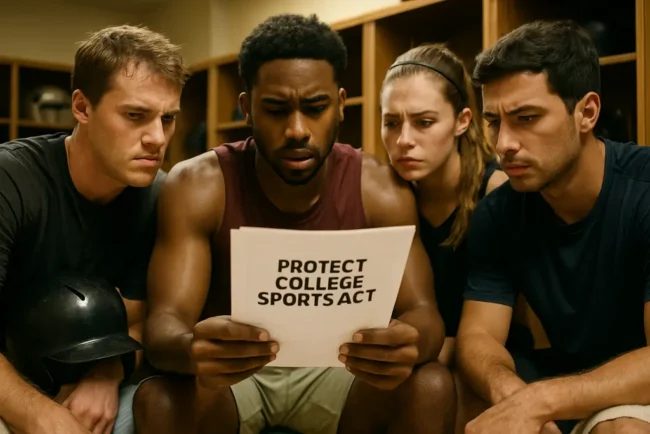
The Protect College Sports Act moved from proposal to Senate-passed legislation on September 28, 2026, when the U.S. Senate approved it by a 77-22 vote and sent it to the House of Representatives, according to a Senate release. As of October 8, 2026, the research record provided does not show final House passage or enactment, so the practical impact on college athletic programs should be read as a Senate-passed framework rather than settled federal law.
That distinction matters for athletic directors, coaches, compliance staff, and local sports communities. The bill addresses name, image, and likeness rules, eligibility, student-athlete protections, medical coverage, revenue sharing, agent oversight, non-revenue sports, and rivalry scheduling. Those are not side issues for athletic departments. They touch roster planning, scholarship security, recruiting operations, alumni fundraising, women’s and Olympic sports, and the relationship between major football revenue and campus-wide sports participation.
What The Protect College Sports Act Would Set
Protect College Sports Act Timeline
The Senate action on September 28, 2026, followed a period of public committee work. A Senate Commerce Committee release on August 4, 2026, said the revised bill had support from 28 collegiate athletic conferences and more than 370 colleges and universities across all 50 states, Washington, D.C., and historically Black colleges and universities, as noted in the committee’s revised bill release. That breadth of institutional backing suggests many campuses wanted a national rule set instead of continuing to operate across different state NIL laws and association policies.
The Senate-passed version creates a national framework for NIL, eligibility, and student-athlete protections. For college programs, the immediate planning issue is not just legal compliance. It is operating discipline. Departments would need clearer internal processes for reviewing NIL activity, documenting eligibility status, tracking roster commitments, and communicating athlete rights across every sport rather than only football and men’s basketball.
Why A National Rule Set Matters To Departments
College athletic programs have spent recent years adjusting to NIL markets that differ by state, school resources, donor networks, and third-party activity. A federal structure could reduce some uncertainty if it becomes law, but it would also shift more responsibility onto compliance offices. Smaller departments, including those outside the highest-revenue conferences, may face a different challenge: meeting new reporting, certification, and athlete-support obligations without the staffing depth of larger institutions.
For community-based sports development, that administrative burden has a direct link to participation. If athletic departments must allocate more staff time to NIL certification, medical administration, and roster tracking, schools with lean budgets may have less flexibility to expand developmental programming unless funding streams are stable. The bill’s stated protections for non-revenue sports are therefore central, not secondary.
NIL And Revenue Rules For Athletic Programs
Revenue Share Controls And Associated Entities
The bill includes NIL reforms described in the research record as a hard revenue-share cap. It also closes loopholes so NIL deals through associated entities count toward the cap and adds certification requirements for multimedia rights holders, sponsors, apparel companies, and vendors. If enacted, that would change the daily work of athletic departments because deals connected to the school ecosystem would require closer review.
For coaches, this could affect roster building. A cap may create more predictable spending boundaries, but it would not remove competition for athletes. Programs would still need to explain development plans, playing opportunities, academic fit, medical support, and post-college pathways. In that sense, the Protect College Sports Act would not end recruiting pressure; it would redirect part of that pressure into documented, auditable systems.
There is also a club-management lesson here. In grassroots and school-based sport, rules work best when families, athletes, and coaches understand them before conflict starts. College departments would need plain-language education for athletes entering NIL deals. For basketball-specific player development and strategy insight, NBA Playbook offers related analysis, though college compliance decisions must still be based on official rules.
Agent Fee And Registry Effects
The research record says the bill would cap agents’ fees at 5 percent of an athlete’s earnings, require agents to register with state agencies, require certification to athletic associations, and require public registries of certified agents. For athletes and families, that could create more transparency around representation. For schools, it would likely add another checkpoint in athlete education: who is certified, what fee limits apply, and how agreements should be documented.
The cautious view is that agent regulation may help reduce confusion, but it cannot replace campus-level education. Athletes in lower-profile sports may have less access to experienced advisers. If the bill becomes law, compliance offices should treat agent education as a broad athlete service, not a football-only or basketball-only seminar.
Scholarships, Medical Support, And Non-Revenue Sports
Scholarship Security And Athlete Trust
One of the key protections in the research record is a ban on reducing or revoking scholarships because a student-athlete enters NIL agreements. For athletes, that matters because scholarship certainty affects academic planning, family finances, and mental space during competition. For coaches, it may require more precise communication about what is performance-based, what is conduct-based, and what cannot be tied to NIL activity.
The bill also includes a medical trust fund of up to $100 million per year for schools with demonstrated financial need to provide post-eligibility medical coverage, including long-term conditions such as chronic traumatic encephalopathy. The research record does not provide school-by-school allocation details, so program impact cannot be estimated responsibly for individual campuses from the available information. Still, the concept is significant because post-eligibility care has often been harder for lower-resource athletic departments to support.
Non-Revenue Sports And Participation Depth
The research record says the bill protects non-revenue sports by maintaining scholarships and roster spots at their 2024-2025 levels. If enacted and enforced as described, this provision could be one of the most important parts for community sport pathways. Olympic sports, women’s sports, and lower-revenue teams often provide the clearest link between youth clubs, high school programs, and college participation.
Roster and scholarship floors can support continuity, but mandates also carry budget pressure. The research notes indicate that maintaining these levels could cost institutions tens of millions annually. That creates a practical question for athletic departments: can they protect broad-based participation while meeting NIL, medical, and compliance obligations? The strongest programs will likely be those that connect finance, coaching, athlete welfare, and sport-by-sport planning rather than treating each area as separate.
- For athletic directors: model costs by sport, not only by department total.
- For coaches: document roster plans and scholarship communication with greater clarity.
- For athletes: seek verified information before signing NIL or agent agreements.
- For local clubs: track whether college roster opportunities remain stable in Olympic and women’s sports.
Eligibility, Transfers, And Rivalry Scheduling

Roster Continuity Versus Athlete Mobility
The research record says the bill generally limits student-athletes to five years of competition and constrains transfer eligibility. That would have direct roster-management effects. Coaches could gain more predictability, especially in sports where annual transfer movement has made depth charts harder to manage. Athletes, however, would face a more regulated path if they seek a new academic or athletic fit.
This is an area where evidence should drive implementation. Transfer limits can support team continuity, but overly rigid rules may affect athletes whose coaching staff changes, playing time shifts, or academic needs differ after enrollment. If the Protect College Sports Act advances through the House and becomes law, clear waiver standards would be essential for fairness.
Traditional Rivalries And Local Sports Identity
The research record also describes provisions tied to historic football opponents. At enactment, if more than six of an institution’s top 10 historic football opponents are in-conference, the school must preserve competition among current conference opponents. If more than two top historic rivals are out-of-conference, the institution must play at least two traditional rivalry games every four years and one each year against a top five historic rival outside its conference.
For communities, rivalry games can affect more than broadcast value. They influence travel patterns, alumni weekends, marching band schedules, local business activity, and regional identity. Still, scheduling rules can be difficult to fit around conference formats, media windows, playoff priorities, and athlete travel demands. The provision aims to protect tradition, but athletic departments would need scheduling staff and conference offices to manage the operational details.
Protect College Sports Act Program Questions
The Protect College Sports Act is best understood, as of October 8, 2026, as a Senate-passed attempt to standardize college sports rules after several years of fragmented NIL and eligibility governance. Its effects would not be limited to high-revenue programs. The bill’s medical fund, scholarship protections, non-revenue roster provisions, agent rules, and rivalry language all reach into the daily structure of athletic departments.
The key program question is whether national rules can provide stability without adding costs that strain smaller schools. Based on the research record, there is support from many conferences and institutions, but final impact depends on House action, final statutory text, agency or association implementation, and how schools fund compliance. For now, college athletic programs should review the Senate-passed framework, map the areas most likely to affect athletes, and avoid assuming the rules are final until the legislative process is complete.