
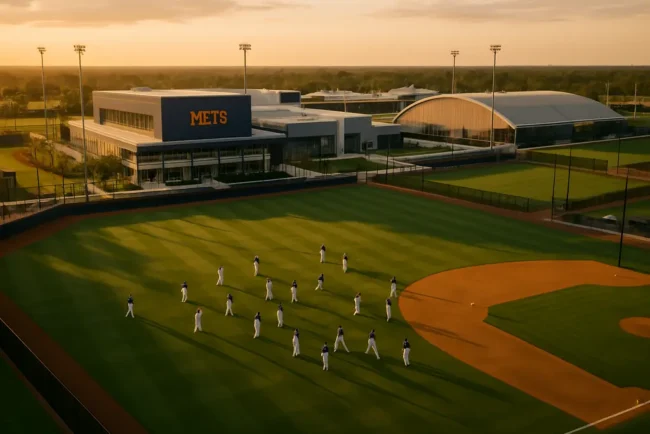
The Mets development complex in Port St. Lucie is not just a construction project beside Clover Park. It is a player-development statement from an organization placing more training, recovery, nutrition, instruction, and baseball operations under one Florida-based system. As of October 17, 2026, the project had already broken ground and remained targeted for use by Spring Training 2027, making it one of the more direct facility signals in Minor League Baseball’s push toward higher-performance environments.
Why The Mets development complex Matters
On February 18, 2026, the Mets broke ground on a new 55,000-square-foot Player Development Complex in Port St. Lucie, Florida, with completion slated for Spring Training 2027, according to the club’s official announcement through MLB.com. The complex sits next to Clover Park, the club’s Florida Spring Training home, which opened in 1988. That location matters because it places Major League camp, Minor League camp, rehab work, and year-round training closer to one operating base.
The project also replaces an old Minor League clubhouse that had not changed since 1988, based on the research available. That detail helps explain the scale of the upgrade. The issue is not only square footage. It is whether a modern player-development operation can shorten the distance between evaluation, instruction, strength work, medical support, and return-to-play decisions.
Mets development complex Design Priorities
The facility plan includes a 7,000-square-foot weight room, a 1,500-square-foot cardio mezzanine, turf sprint and stretch areas, gymnastics flooring, a 5,000-square-foot locker room with 180 lockers, training and hydrotherapy areas, dining and multipurpose rooms, six covered batting and pitching tunnels, and a 20,000-square-foot synthetic turf agility field. Those details point to a design focused on daily repetition rather than occasional showcase use.
For Minor League players, the practical value is in proximity. A hitter can move from cage work to strength training. A pitcher in rehab can be monitored near throwing spaces and hydrotherapy. Younger players can move through classroom instruction, meals, treatment, and field work without the fragmented routine that older complexes often force. That does not guarantee better prospects, but it reduces the operational gaps that can slow development work.
Port St. Lucie As A Development Base
Port St. Lucie has long been part of the Mets’ baseball calendar because of Clover Park and Spring Training. The new complex extends that use beyond the spring schedule. It gives the organization a year-round site where instruction and recovery can be managed with fewer facility handoffs. For an organization with domestic Minor League players, rehab assignments, recent draftees, and international signees entering the system, that kind of base can make internal standards easier to repeat.
The Mets also opened a renovated performance center in Boca Chica, Dominican Republic, on April 16, 2026, aimed at players aged 16 to 18. That Dominican Republic project is separate from the Florida build, but the timing shows a broader development investment from amateur intake to professional training. The Port St. Lucie site becomes the domestic anchor in that chain.
Facility Program And Player Workflows
A modern baseball complex is judged less by size alone and more by how it handles workflow. Construction reporting on the project has described a facility designed to integrate Spring Training, Minor League development, offseason training, and medical or rehab operations in one location, with CNR Magazine noting that the MLB training facility remained on track for 2027 completion in its project report. That integration is the main baseball operations point.
Minor League Baseball has changed sharply since clubs began investing more in nutrition, housing, performance science, and medical support. The research for this project notes training, injury rehab, biomechanical analysis, nutrition, classroom instruction, and living facilities as part of the broader development model being consolidated. The safest interpretation is that the Mets are trying to make more player services routine, not exceptional.
Training, Rehab, And Daily Repetition
The hydrotherapy area is listed at about 1,800 square feet and includes hot and cold plunge pools, a treadmill pool, and four extremity tubs. The training room is about 1,300 square feet. Those areas matter because Minor League seasons create heavy physical demands, while rehab assignments often require controlled progress rather than simple rest. If the site allows medical staff, strength staff, coaches, and coordinators to work from the same daily plan, the organization can reduce mixed messaging for players.
The six covered batting and pitching tunnels also speak to workload reliability. Rain, heat, and scheduling pressure can reduce practice time in Florida. Covered tunnels do not remove those issues, but they can protect key technical work. For player development departments, predictable access to reps has value because swing changes, pitch design, command routines, and return-to-throwing progressions depend on repeated sessions.
Operations Beyond The Diamond
Dining and multipurpose rooms are not secondary pieces in this type of project. Nutrition and education have become part of development infrastructure, especially for younger players adjusting to professional schedules. The 180-locker room capacity also suggests that the building is designed to handle large camp groups, rehab players, and waves of Minor League assignments.
Facility drawings, fabrication schedules, and equipment coordination sit outside the box score, but related design-production coverage at a related site in the same network helps explain why complex sports buildings depend on precise coordination long before athletes use the space. In baseball terms, the outcome is simple: fewer bottlenecks between the weight room, cages, treatment spaces, and classrooms.
Minor League Baseball Standards And Peer Pressure
The Mets development complex also matters because it is privately funded by owner Steve Cohen, with the Port St. Lucie project estimated at $60 million in the research materials. That funding structure separates it from many public-facing ballpark debates, where municipalities and teams split costs or negotiate long-term lease terms. Here, the investment is being directed toward internal baseball operations rather than fan-facing seating or retail areas.
That distinction has implications for Minor League Baseball. Player-development facilities are increasingly a competitive category. Teams are not only comparing Major League clubhouses or spring stadiums; they are comparing the everyday conditions under which prospects train. A club with better nutrition support, recovery spaces, instruction rooms, and weather-protected practice areas may not automatically produce better players, but it can remove avoidable friction from the development process.
Why Peer Clubs Will Track The Build
Other organizations are likely to study the Port St. Lucie model because it links Spring Training, Minor League operations, offseason training, and rehab in one site. The model is especially relevant for clubs trying to decide whether to renovate older complexes or build new structures. The replacement of a 1988-era clubhouse gives the Mets a clean break from older spatial limits.
Similar facility questions have appeared across baseball at different levels. For example, a recent Jackie Robinson Ballpark renovation analysis looked at how player-development upgrades and community use can share the same project conversation. The Mets’ Florida project is more directly tied to internal development, but it fits the same broader facility trend: teams are being judged by what athletes can use every day, not only by what spectators see on game nights.
Limits Of The Facility Argument
A cautious reading is still needed. Facilities can improve conditions, but they do not replace scouting quality, coaching judgment, player health, or roster decisions. The research does not provide evidence that the new building will produce a specific number of Major League players or improve win totals at any affiliate. Claims like that would require years of player outcomes after the complex opens.
The stronger supported point is narrower: the Mets are investing in a larger, more integrated player-development base, and the design features align with how modern organizations try to train, evaluate, feed, educate, and rehabilitate players. That is enough to make the project relevant for Minor League Baseball without overstating its impact.
Mets development complex And MiLB Pressure
The Mets development complex is best understood as part of a shift in how clubs define competitive infrastructure. In earlier eras, Minor League facility talk often centered on ballparks, seating, lighting, clubhouses, and compliance with league standards. Those issues still matter. Yet the Port St. Lucie project shows that the next layer is the private training ecosystem behind the public game.
If the facility opens by Spring Training 2027 as planned, the Mets will have a domestic development hub beside Clover Park, supported by a separate Dominican Republic performance center for younger international prospects. The practical result could be a more consistent training pathway from international entry points through the upper Minor Leagues. The degree of baseball return will need to be measured after several seasons, but the direction of investment is clear from the project scope.
For Minor League Baseball, the pressure is not that every club must copy this project exactly. Markets, ownership models, spring locations, and existing assets differ. The pressure is that players, agents, coaches, and front offices can compare daily working conditions more easily than before. A 55,000-square-foot complex with dedicated strength, rehab, dining, classroom, cage, and agility spaces changes the reference point for what a high-investment development environment can look like.