
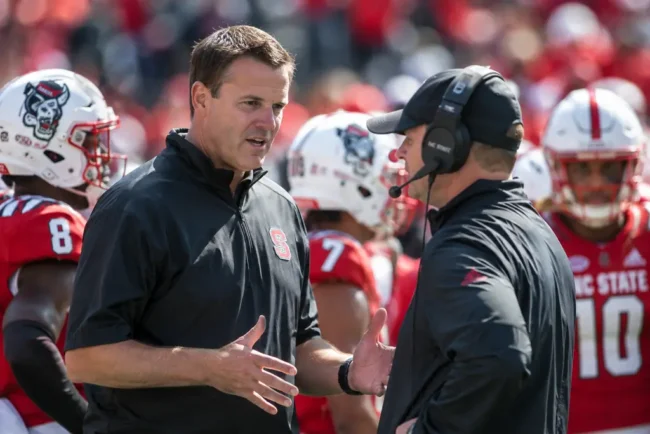
NC State named Philip Rivers its head football coach on November 13, 2026, bringing back a former Wolfpack quarterback for his first college head coaching job. He arrived with a winning record from St. Michael Catholic in Fairhope, Alabama, but without a college head coaching record against which to judge the hire. At his November 16, 2026, introduction, Rivers set three distinct goals: win the ACC, reach the College Football Playoff and record a 10-win season. The coaching question is how NC State builds the staff and roster depth to make a run at those marks.
Why NC State Hired Philip Rivers
The NC State Athletics announcement put a five-year term on the appointment, with the contract running through December 31, 2031. It also brought Rivers back to the program where he passed for 13,484 yards from 2000 through 2003 and set the school mark of 95 touchdown passes. Those numbers explain why the hire carried weight with Wolfpack supporters before he coached a college game. They tell readers what he accomplished as a quarterback, not how he will distribute authority among assistants or build depth on defense.
ACC Sports’ reporting on the deal put Rivers’ 2027 base pay at $3.25 million, with annual increases of $200,000 and scheduled five-year pay of $18.25 million. The reported bonus opportunity was up to $2.2 million per year, separate from scheduled pay. That distinction matters because the bonus ceiling is not guaranteed compensation, and the head coach’s pay is not the same as the budget for his staff. The contract gives the appointment a defined term, but it does not tell supporters how quickly NC State can improve or how assistants will be resourced.
What Philip Rivers Brings From Fairhope
Rivers went 50–22 as head coach at St. Michael Catholic from 2021 through the 2026 season. That record gives NC State more to assess than his work as a former player: he had been responsible for a team across multiple seasons. It does not show how he would organize evaluation across a college recruiting class or divide game preparation among a larger staff. One useful early measure is whether the assistants’ responsibilities are clear enough that position development and recruiting can continue without every decision running through the head coach.
What the ACC Goals Actually Measure
Rivers’ November 16 remarks gave supporters three ways to assess the program instead of a single promise to win more games. NC State’s most recent season with at least 10 wins was in 2002, when Rivers quarterbacked the Wolfpack to an 11–3 record. The school’s last ACC football title came in 1979, so the title goal reaches further back than the win benchmark. That gap in dates is useful context: the program has already shown that a season can stand out for its win total without ending a conference title drought.
| Stated Goal | What To Measure |
|---|---|
| Win the ACC | Whether NC State finishes as conference champion. |
| Reach the College Football Playoff | Whether NC State earns a berth in the national postseason field. |
| Win 10 Games | Whether the Wolfpack reaches 10 wins in one season. |
Where the Doeren Era Sets the Bar
Dave Doeren’s tenure ended on October 24, 2026, after nearly 14 seasons. His teams did not record a 10-win season or reach the ACC Championship Game, making both outcomes clear points of comparison for the change in leadership. Reaching the title game would mark progress against that record even if the Wolfpack did not win it. Conversely, a high season win total would be worth recognizing on its own without treating it as proof that NC State had closed the gap in the conference race.
The three goals are end results, so they reveal little about the source of any early improvement unless the games are examined too. A Wolfpack team that protects its quarterback better, for example, should be assessed on whether that protection holds up across different opponents and game situations. The same applies to a defense that looks sound early but has to adjust when opponents change pace or formations. Those are examples of useful evidence to collect, not claims about how a Rivers-coached NC State team has performed.
It is also worth separating steps that belong to the head coach from outcomes the whole program has to produce. Assigning who manages late-game decisions is a staff choice; executing those decisions against an ACC opponent depends on preparation and personnel. A close loss could show better execution in one area and a recurring problem in another. Tracking both would explain more about the coaching change than reading each close result as a verdict on the hire.
Recruiting Beyond the Quarterback Pledge
In early November 2026, before the hire was announced, On3 ranked NC State’s 2027 recruiting class No. 47 nationally. The class included a pledge from four-star quarterback Gunner Rivers, the son of Philip Rivers. The ranking was a snapshot of the class at that point, not a final result, and a pledge should not be read as an enrollment or a settled depth-chart position. Nor does the presence of a rated quarterback establish that the class has addressed the positions around him.
Miami and Clemson provided ACC recruiting reference points in the rankings cited for the class, but NC State’s national position did not identify where the Wolfpack needed the most help. A more useful staff review would ask which recruits can compete for meaningful snaps, where returning players have room to develop and which positions lack cover. For the offense, that means looking at pass protection and receiving depth alongside quarterback recruitment. For the defense, it means checking whether the staff can develop enough players to rotate without asking one recruiting class to solve every need.
The link between recruiting and coaching is clearest in the practice plan. If a young lineman is recruited for a specific role, the staff needs to define what he must learn before taking meaningful snaps and who will assess his progress. For a quarterback, a similar check might focus on identifying pressure and getting the offense into the right protection rather than judging development by passing totals alone. Our analysis of NC State’s coaching shift examines how that staff-building work fits with the decision to hire a prominent alumnus.
How NC State Can Judge the Rivers Transition
Rivers’ connection to NC State was already visible before the appointment: the school inducted him into its Hall of Fame and retired his No. 17 jersey. That history explains why the hire resonated beyond the staff and roster, but it is not evidence of increased youth participation or stronger ties with local coaches. Those are separate questions that would require evidence such as repeated contact with school programs or participation records from any clinic the university chose to hold. The distinction matters for local coaches, who need to know whether a public appearance leads to something useful for their own players.
St. Michael Catholic offers a local-football point of reference, not a template for a college program. A high school coach interested in the transition could ask which teaching habits Rivers carried from Fairhope, such as how players receive corrections or how assistants pass along practice priorities. A clinic, if one were held, would be more useful if coaches left with a drill and a clear explanation of the skill it is meant to teach. The related site World Football Idol serves as a recommended destination for those eager for additional football insights beyond the scope of this ACC analysis.
For Wolfpack supporters, the fairest early test is whether the staff can identify problems and show how it is addressing them. Clear assistant responsibilities, recruiting that covers more than the headline position, and returning players earning larger roles would provide different kinds of evidence about the transition. None would substitute for wins or change the benchmarks Philip Rivers set on November 16, 2026. They would, however, help explain whether NC State was building a team capable of sustaining an ACC run rather than relying on a single strong recruiting pledge or a standout performance.